Appliance and Supply Hose Leaks in Monroe Township, NJ
A burst washer hose or a cracked ice maker tube can run under cabinets and flooring for hours before anyone sees it. The drying team pulls the water and dries the cabinets, subfloor and walls.
(888) 471-9821Report the hose or appliance leak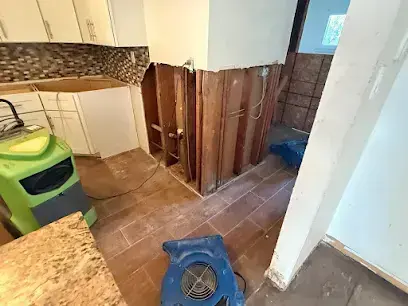
First steps for appliance and supply hose leaks in Monroe Township
- 1
Close the appliance valve
Behind the washer, under the sink or behind the fridge.
- 2
Unplug the appliance
If the outlet and cord are dry.
- 3
Soak up what you can
Towels on hardwood; do not use fans on Category 2 water.
- 4
Photograph the hose and the floor
Insurers ask for the failed part.
How appliance and supply hose leaks is handled in Monroe Township
- L1
Extract
Standing water off the floor first.
- L2
Map
Meters under cabinets and flooring.
- L3
Open up
Toe kicks and wet baseboards removed.
- L4
Dry and verify
Readings until subfloor and walls are dry.
What does appliance and supply hose leaks cost in Monroe Township, NJ?
In Monroe Township, NJ, appliance and supply hose leak cleanup typically runs $800 to $5,000, set by how long the leak ran, the flooring and whether cabinets or the floor below are wet.
- Extraction
- Air movers
- Readings
- Toe kicks pulled
- Subfloor drying
- Dehumidifier
- Cabinets and flooring out
- Room below
- Extended drying
Ranges are typical, not a quote: the water category, square footage, material class and how fast drying started move the number most. The Monroe Township water damage cost calculator gives a closer planning range.
Appliance leaks are among the most common indoor losses in Monroe Township. Many happen while owners are out for the day or away for the season, so water has time to spread under cabinets and flooring.
The usual sources
- Washing machine supply hoses and drain hoses.
- Dishwasher supply and drain connections under the counter.
- Refrigerator ice maker tubing behind the fridge.
- Toilet supply hoses and fill valves.
Supply hose water is clean Category 1. Washer and dishwasher drain water is gray Category 2 and gets an antimicrobial before drying.
How cabinets and floors are dried
The extraction crew pulls water from the floor, then the tech who does the walkthrough checks under cabinets, behind the toe kicks and under laminate and tile with meters. Toe kicks are pulled so air can reach under base cabinets, and air movers and a dehumidifier dry the subfloor and wall bottoms. Hardwood gets its own approach; see hardwood floor water damage.
Preventing the next one
Braided stainless hoses, a leak sensor near the washer and closing the washer valves before a trip all help. The EPA WaterSense program lists simple leak checks, and Ready.gov covers home preparedness before long trips and storm season.
Appliance and supply hose leaks across Monroe Township and nearby towns
Monroe Township Water Damage Restoration covers ZIP 08831 from Rossmoor, Clearbrook and Concordia to Whittingham, Applegarth, Prospect Plains and the homes along Route 33 and Spotswood-Englishtown Road.
Nearby coverage reaches Jamesburg, Spotswood, Helmetta, Cranbury, South Brunswick, Hightstown.
Appliance and Supply Hose Leaks questions in Monroe Township, NJ
How often should washer hoses be replaced?
Rubber hoses are commonly replaced about every five years. Braided stainless hoses last longer but still need checks.
Can kitchen cabinets be dried in place?
Often, if the boxes are not swollen. Toe kicks come off so air can reach underneath.
Is appliance leak damage covered by insurance?
Sudden failures usually are; slow leaks may not be. Coverage depends on your policy, so check with your own insurer.
Is dishwasher water dirty?
Drain water is gray Category 2 and gets cleaned before drying. Supply water is clean.
How long does drying take?
Usually two to five days, longer under cabinets or tile.
What about a leak sensor?
A sensor near the washer or water heater gives an early warning; some models also close the supply valve.
Hose let go? Have the floors and cabinets dried today.
The team extracts the water and dries the cabinets, subfloor and walls to the IICRC S500 goal.