Structural Drying and Dehumidification in Monroe Township, NJ
Surface-dry is not dry. The drying team sets air movers and LGR dehumidifiers to each room's evaporation load and takes readings every day until framing, subfloor and concrete match a dry reference in the same house.
(888) 471-9821Book structural drying now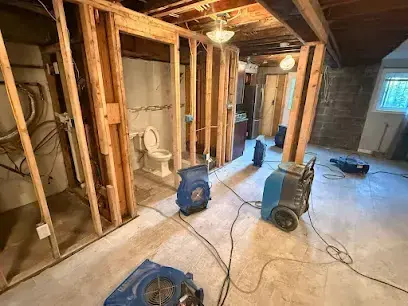
First steps for structural drying and dehumidification in Monroe Township
- 1
Remove standing water
Drying cannot start on a flooded floor.
- 2
Open closed rooms
Unless containment is set up.
- 3
Keep the heat moderate
Very high heat without dehumidifiers spreads humidity.
- 4
Leave equipment running
Turning it off resets progress.
How structural drying and dehumidification is handled in Monroe Township
- L1
Map
Moisture mapped with meters and thermal imaging.
- L2
Set
Equipment sized to the class of loss.
- L3
Log
Daily psychrometric and material readings.
- L4
Verify
Equipment leaves when readings hit the goal.
What does structural drying and dehumidification cost in Monroe Township, NJ?
In Monroe Township, NJ, structural drying typically runs $1,000 to $6,000, set by the number of rooms, the class of loss, the materials and how many days of equipment the readings call for.
- Air movers
- LGR dehumidifier
- Daily logs
- Multiple dehumidifiers
- Cavity drying
- Containment
- Desiccant units
- Hardwood or slab
- Extended drying
Ranges are typical, not a quote: the water category, square footage, material class and how fast drying started move the number most. The Monroe Township water damage cost calculator gives a closer planning range.
Structural drying is the part of a water loss that decides whether problems show up months later. Wet framing, subfloor and concrete that look dry can hold enough water to warp floors, peel paint and grow mold.
How drying is planned
- Class 1 to 4 sets how much equipment a room needs, from a small wet area to dense materials like hardwood and concrete.
- Air movers are placed to the room's evaporation load, not by habit.
- LGR dehumidifiers handle most losses; desiccants take on Class 4 and cold basements.
- The room is closed off so equipment works on the right air.
How dry is verified
The drying team logs temperature, relative humidity and grains per pound inside and outside the drying area each day, along with readings on every wet material. Dry means a reading within 2 to 4 points of a dry reference material in the same house. Equipment is moved as areas dry, and comes out only on the numbers. Summer humidity in central New Jersey makes the dehumidifiers work harder in basements. See basement flooding cleanup for lower levels.
Why it matters for the claim
The drying logs are proof that the structure was dried to the standard, which matters to adjusters and to buyers later. EPA moisture guidance explains why drying within 24 to 48 hours limits mold, and the Department of Energy Energy Saver pages cover humidity and ventilation in homes.
Structural drying and dehumidification across Monroe Township and nearby towns
Monroe Township Water Damage Restoration covers ZIP 08831 from Rossmoor, Clearbrook and Concordia to Whittingham, Applegarth, Prospect Plains and the homes along Route 33 and Spotswood-Englishtown Road.
Nearby coverage reaches Jamesburg, Spotswood, Helmetta, Cranbury, South Brunswick, Hightstown.
Structural Drying and Dehumidification questions in Monroe Township, NJ
What does structural drying mean?
Drying the building itself, framing, subfloor, walls and concrete, not only the carpet and surfaces you can see.
How long does structural drying take?
Usually three to five days for Class 1 or 2, longer for Class 3 and 4 materials like hardwood and concrete.
Why is the equipment so loud?
Air movers push large volumes of air across wet surfaces. The noise ends when readings say dry.
Can I turn the equipment off at night?
It is best not to. Turning it off lets humidity rise and slows drying.
What is an LGR dehumidifier?
A low grain refrigerant unit that pulls more water from air than a household dehumidifier, even when the air is already fairly dry.
How do you know it is dry?
Readings on wet materials are compared with a dry reference material in the same house. Within 2 to 4 points is the goal.
Walls and floors still wet? Get them dried to the standard.
The team sizes equipment to the loss and logs readings daily until everything meets the IICRC S500 goal.