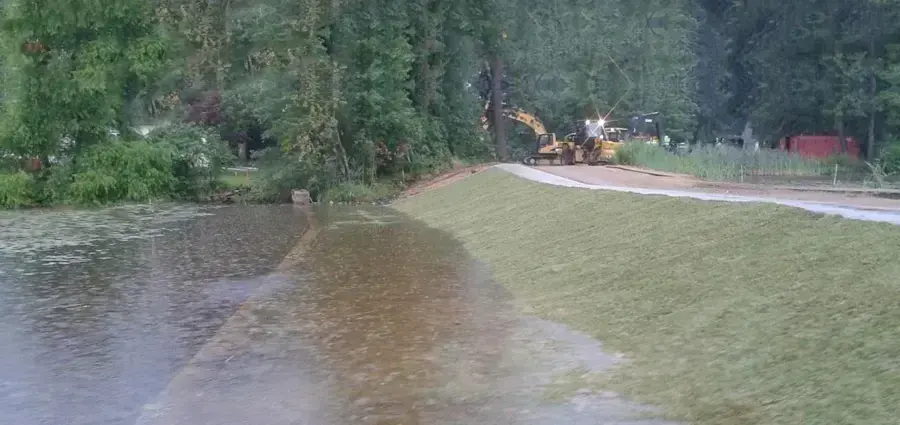
Spotswood sits where Manalapan Brook and Matchaponix Brook meet to form the South River, and the National Weather Service tracks the brook with a gauge named Manalapan Brook at Spotswood. Knowing what each reading means gives a household time to act before water reaches the door.
Key takeaways
- The gauge has an action stage of 18.5 feet and minor, moderate and major flood stages of 19, 21 and 22 feet.
- At 19 feet Mundy Avenue is subject to flooding and closure; at 21 feet Devoe Avenue floods and both roads become impassable.
- At 22 feet residential and township properties take on water, and the Immaculate Conception parking lot floods.
- The highest crest on the Weather Service list is 22.22 feet, during Hurricane Irene on August 28, 2011.
- A rising gauge is the signal to move belongings up and arrange extraction, not to wait for the water to enter.
The gauge behind the numbers
Manalapan Brook flows into Devoe Lake in Spotswood, also called Spotswood Lake. The brook watershed includes Monroe Township, Jamesburg, Helmetta and Spotswood, so rain upstream can show up on the Spotswood gauge later.
The National Weather Service also notes that downstream tides can affect Devoe Lake levels and flooding. A reading that looks modest can therefore matter more when the lake cannot drain freely.
- Action stage: 18.5 feet, the point to start paying attention.
- Minor flood stage: 19 feet.
- Moderate flood stage: 21 feet.
- Major flood stage: 22 feet.
What each stage puts under water
The Weather Service ties each stage to real places in the borough. Those places are the best measure of how serious a reading is for a given household.
A family on a street that never floods may still lose the road out, while a home near Devoe Lake may see water sooner than the stage suggests. The numbers set the pace, and local knowledge fills in the rest.
At 19 feet: Mundy Avenue
Mundy Avenue, which connects Spotswood and Old Bridge, is subject to flooding and closure at the 19 foot stage.
Mundy Avenue was closed until further notice because of flooding on May 28, 2018, when the brook crested at 19.46 feet.
At 21 feet: Devoe Avenue and nearby properties
At the 21 foot stage Devoe Avenue floods, both Devoe and Mundy Avenues become impassable, and flood water approaches residential and township properties.
This is the stage where a household near Devoe Lake should already have valuables off the floor.
At 22 feet: homes and a school lot
At 22 feet the Immaculate Conception parking lot takes on water, and residential and township properties take on water as well.
The brook crested at 22.22 feet during Hurricane Irene on August 28, 2011, the highest crest on the Weather Service list.
Past crests worth remembering
Three crests give a feel for how often the brook climbs past its minor stage.
It reached 20.42 feet on July 18, 2005, then 22.22 feet on August 28, 2011. A later crest of 19.46 feet came on May 28, 2018.
Each of those readings sits at or above the 19 foot minor stage, which is why local households treat the gauge as something to watch rather than ignore.
- July 18, 2005: crest of 20.42 feet.
- August 28, 2011: crest of 22.22 feet during Hurricane Irene.
- May 28, 2018: crest of 19.46 feet, with Mundy Avenue closed until further notice.
What to do while the gauge is climbing
Once the gauge passes the action stage, the useful work is preparation. A household that moves things early loses less and has a clearer start when water arrives.
Spotswood also keeps flood hazard maps on file with the Zoning Officer at borough hall, which is a place to learn how a particular property is mapped.
- Lift furniture, boxes and electronics off the floor or to an upper level.
- Move vehicles to higher ground before roads close.
- Shut off power to wet areas only if the panel can be reached without standing in water.
- Photograph the rooms, the water level and any markings left on walls.
- Keep medications, documents and phone chargers in one bag.
When water is already inside the house
Brook water is not clean water. It crosses roads, yards and parking lots before it reaches a doorway, so it is treated as contaminated and the cleanup differs from a pipe leak.
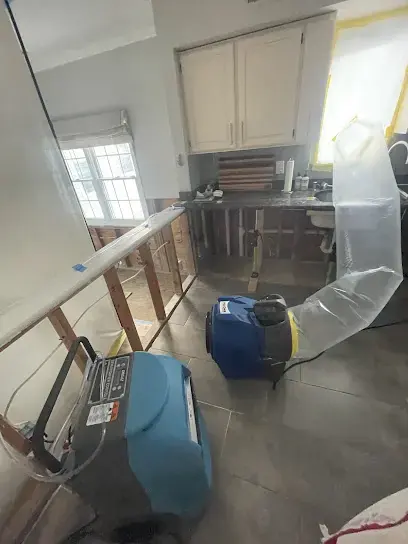
The first step is pump out. The extraction crew removes standing water with pumps and wet vacuums, and water extraction in Spotswood starts as soon as it is safe to enter.
Safety checks come before pumps. The team confirms power is off to wet circuits, looks for hazards underfoot and wears protective gear, because brook water can carry sewage and debris.
What the team removes
Carpet, pad and soaked insulation that took in brook water are removed instead of dried in place, and drywall is cut above the waterline.
Hard floors, sealed concrete and framing are cleaned and treated with antimicrobial products.
What stays and dries
Studs, subfloor and structural wood stay and are dried with air movers and dehumidifiers while moisture meters track the results.
After the brook falls: drying and checking
A falling gauge does not mean the house is dry. Water that stood against walls and floors leaves moisture behind, and that moisture keeps spreading until it is measured and removed.
The drying team uses moisture meters and thermal imaging to find wet areas that are not visible, then sets air movers and dehumidifiers to match.
Wall cavities and framing
Brook water that rose against a wall can soak insulation and the bottom of the studs. Cutting a small opening at the base often shows whether the cavity is wet.
Wet insulation holds water against framing, so it comes out and the cavity is dried before closing it up.
Floors and contents
Subfloors and the underside of flooring dry more slowly than the surface. Readings are repeated each day until they match a dry reference.
Furniture and belongings that sat in brook water are sorted into what can be cleaned, what needs restoration and what is discarded.
- Photograph items before sorting them.
- Keep a list of discarded belongings with approximate values.
- Ask the insurer what documentation it wants before large items leave the house.
Putting the stages to use before the next storm
Households near Devoe Lake and low streets can write the stages on a card kept near the fuse panel.
At the action stage, start moving belongings. At the minor stage, arrange help, and at the moderate stage, treat the situation as a likely flood.
Spotswood residents who want more detail on cleanup can read about storm and flood water cleanup in Spotswood or the wider Monroe Township storm cleanup service.
The Spotswood water damage team handles loss from brook flooding and from other sources of water inside a house.
- Check the gauge reading during any long rain.
- Charge phones and keep a flashlight handy.
- Know which way the nearest roads close first.
- Keep a short list of insurance contacts and policy numbers in a waterproof bag.
Questions
What does the action stage on the Manalapan Brook gauge mean?
The action stage is 18.5 feet. It is the point below the minor flood stage where the Weather Service expects people to watch conditions closely and prepare.
At what reading does Mundy Avenue flood?
Mundy Avenue is subject to flooding and closure at the 19 foot stage, and it was closed until further notice on May 28, 2018, when the brook crested at 19.46 feet.
When does water reach homes?
At the 21 foot stage flood water approaches residential and township properties, and at 22 feet residential and township properties take on water.
Can high tides make Devoe Lake flooding worse?
The Weather Service notes that downstream tides can affect Devoe Lake levels and flooding, so a storm that coincides with high tides can hold water higher for longer.
Is brook flood water cleaned up like a pipe leak?
No. Brook water crosses roads and yards before reaching a house, so it is treated as contaminated, with porous materials removed and hard surfaces cleaned and treated.